




Trust is the foundation of every successful brand, but it’s not built overnight. It’s earned through authentic connections, consistent value, and a commitment to delivering on your promises. Here we show how local brands can leverage proven strategies to foster trust, stand out in competitive markets, and create lasting relationships.
Key Takeaways
- The buyer's journey has become more complicated. Your marketing strategy doesn't have to. Customers now move between stages in messy, unpredictable ways, but that doesn't mean you need to be on every platform at once.
- The Buying Funnel still works. People still travel from Unawareness to Awareness, Comprehension, Conviction, and Action. What's changed is how they move between those stages.
- Depth first, then breadth. Invest deeply enough in the right channel to actually reach the right audience with enough frequency to work, before you spread yourself thin.
- "Fill the Bucket" beats chasing everything. A modest budget split across eight platforms makes you visible everywhere and invisible everywhere. Fill one bucket, measure it, improve it, then add another as you grow.
- Digital trust compounds. Branded trucks, a strong facility, hundreds of reviews, and a consistent radio presence aren't things a business bought overnight. They're trust signals built one customer at a time.
- You don't need to be everywhere tomorrow. You need to be somewhere effectively today.
The Journey Got Messier. Your Plan Shouldn't.
Here's a scenario every growing business owner will recognize.
Someone hears your name on the radio during their morning commute. They do nothing. Three weeks later, they hit a problem. They ask ChatGPT what might be causing it. Then they Google the problem itself and see one of your competitors. They read a few reviews. Somewhere in the back of their mind, they remember hearing your name. So they search for you directly. They land on your website, then hop over to Facebook, then ask a friend, then watch a YouTube video, then circle back to Google one more time to check your review rating.
Then they call you.
Good luck putting a tidy attribution bow around that.
The customer journey has become more complex, less linear, and packed with more trust signals than ever before. That's the reality. But here's the distinction worth hammering home, because it changes everything about how you should spend your budget:
The buyer's journey has become more complicated. Your marketing strategy doesn't have to.
A complicated journey does not require a complicated marketing plan. In fact, the businesses winning right now are often the ones doing fewer things, but doing them deeply and consistently enough to matter.
The Buying Funnel Still Works
Before we talk about AI, reviews, radio, and everything else, let's ground ourselves in something that hasn't changed...the Buying Funnel. Human decision-making still follows a predictable path: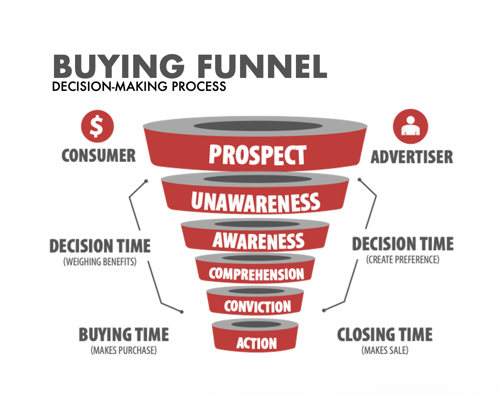 At the top, a prospect doesn't know you exist. Something triggers a need, and they enter Awareness. In Comprehension, they start to understand their problem and realize a solution exists. In Conviction, they weigh their options and decide which one fits best. At Action, they buy.
That framework is still your roadmap. People haven't suddenly abandoned these stages. What's changed dramatically is how they travel between them.
Years ago, you could draw a clean line: hear an ad, Google the business, visit the website, call. One neat path from Awareness to Action. Today, that path zigzags across a dozen touch points, platforms, and days or weeks of quiet consideration. A customer might loop back through Comprehension three times before they ever reach Conviction.
This is exactly why so many growing businesses feel scattered. They see the complexity and assume they need to match it with complexity of their own. They don't. They need to understand the funnel, then build trust at each stage in a way they can actually sustain.
The "Fill the Cup" Philosophy
Say you're a business with a $3,000 monthly marketing budget. Somewhere along the way, a well-meaning voice told you that you need an "omnichannel strategy." So you split that money across eight platforms.
Congratulations. You're everywhere.
And you're invisible everywhere.
Spread that thin, no single channel gets enough investment to reach enough of the right people with enough frequency to actually work. You've bought presence without impact.
There's a smarter way, and it's simple enough to remember: depth first, then breadth.
Here's how the cup philosophy works in practice:
- Identify the right cup. Find the marketing channel, or combination, that gives your business the strongest opportunity to reach enough of the right audience with enough frequency to move the needle.
- Fill it. Invest deeply enough that the channel can actually perform.
- Measure it. Watch what happens. Track the outcomes that matter, not just the vanity metrics.
- Improve it. Refine, optimize, and strengthen what's working.
- Keep doing it. Consistency is where the compounding begins.
Then, as your revenue grows and your marketing budget grows with it, you add another strategic cup. Now you're expanding the number of places customers can encounter and verify your business, without sacrificing the effectiveness of what you've already built.
That's a much healthier version of multi-channel marketing. You're not chasing channels. You're earning the right to add them.
The Pickup Truck Story
Picture the established local company everyone in town knows. The beautiful facility. Hundreds of employees. A fleet of branded trucks driving down every major road. Nine hundred Google reviews. A radio campaign they've run consistently for years.
It would be easy to look at that company and think, as a small business, "See? I need to market like them."
That's discouraging.
It's also absurd.
Because they didn't market like that when they owned one pickup truck with a magnetic sign on the door.
They built. They invested in the right things at the right time. Their customer base grew. Their revenue grew. Their marketing grew alongside it. Their visibility grew. Their reputation grew. And eventually, the business itself became a trust signal.
Think about everything that company now radiates without buying a single new ad:
- Those branded trucks driving around town are marketing.
- The beautiful facility is marketing.
- The employee wearing the company shirt at lunch is marketing.
- The 800 Google reviews are marketing.
- The radio campaign they've run for years is marketing.
- Their website is marketing.
- Someone recommending them at church is marketing.
- Google recognizing them as an established local entity is part of their digital footprint.
- AI tools knowing who they are becomes another piece of it.
Every one of those is a trust signal, and every one of them was earned over time. Digital trust isn't something they bought. It's something they built.
That's the message that matters for a growing business. The company you admire didn't skip stages. They filled one cup, then another, then another, over years of smart, consistent investment. You can do the same, starting exactly where you are.

How Trust Gets Built at Each Stage
The cup philosophy and the Buying Funnel work together. Each stage of the funnel is really an opportunity to earn a little more trust, and different tactics do different jobs.
Unawareness and Awareness. This is where you plant your name. Radio, brand campaigns, and consistent presence put you on the map before a customer even has a need. When the trigger finally comes, they already have a name in mind.
Comprehension. Now they're researching. This is where your website, helpful content, and clear answers to real questions do the heavy lifting. Customers are trying to understand their problem and whether you're the kind of business that can solve it.
Conviction. Here's where reviews, reputation, and social proof close the gap. A steady stream of recent, positive reviews tells both humans and the AI systems increasingly making recommendations that you're active, trusted, and real. Consistent business information across every platform reinforces that you're stable and legitimate.
Action. Make the next step effortless. A clear phone number, an easy form, obvious directions. Remove every ounce of friction between decision and contact.
You don't have to attack all five stages with equal force from day one. You start where your customers most need to encounter you, fill that bucket, and expand your reach into other stages as your budget allows. That's how a scattered plan becomes a strategic one.
Why Depth Beats Breadth for Growing Businesses
For companies in growth mode, the temptation to do everything is strong. New product launches, competitor campaigns, unmet quarterly targets, and expansion plans all create pressure to move fast on every front at once.
Resist it.
Scattered spending produces scattered results. The channels never get enough investment to build momentum, so you're constantly starting over instead of compounding. Depth-first marketing does the opposite. It lets a single channel gain enough traction to generate real, measurable outcomes: higher conversion rates, more qualified leads, stronger brand recognition, and better return on every dollar.
And here's the part that makes it sustainable. When one bucket is genuinely working and paying for itself, funding the next one gets easier. Growth funds expansion. Expansion multiplies your touchpoints. More touchpoints give customers more ways to encounter and verify your brand across their messy, non-linear journey.
That's not 'being everywhere for the sake of it'. That's building a footprint your competitors can't easily dislodge, one deliberate layer at a time.
Where This All Lands
The conclusion is not "you need to be everywhere." It's almost the opposite.
You don't need to be everywhere tomorrow. You need to be somewhere effectively today.
Build awareness. Establish credibility. Give customers clear ways to verify what you say about yourself. Make it easy to take the next step. Then, as your business grows, intentionally expand the number of places where customers can encounter and validate your brand.
That's how a pickup truck with a magnetic sign becomes a fleet. Not by chasing every shiny new marketing opportunity that rolls by, but by making smart investments, sticking with them long enough to work, and building trust... one customer at a time.
This is the honest version of digital trust building. It isn't an intimidating checklist demanding SEO, social, radio, video, reviews, and a dozen acronyms all at once. It's four moves you can actually make:
- Understand how your customer buys.
- Invest enough to make your marketing work.
- Build trust at each stage.
- Expand strategically as you grow.
At Zimmer Communications, that's the approach we help growing businesses put into action. We start by understanding your customer's journey, then help you fill the right bucket deeply enough to see real results before we ever talk about adding the next one. Depth first. Then breadth.
Because the buyer's journey has become more complicated. Your marketing strategy doesn't have to.
Frequently Asked Questions
What does "Fill the Bucket" actually mean?
It's a simple philosophy for spending a marketing budget wisely. Instead of splitting your money across many platforms and hoping something sticks, you identify the one channel or combination that best reaches your audience, invest in it deeply enough to work, measure the results, and improve it. Once that bucket is performing and your budget grows, you add another. Depth first, then breadth.
Doesn't a complex customer journey mean I need to be on every channel?
No, and this is the biggest misconception we see. A complicated journey does not require a complicated plan. Customers move through many touchpoints, but you build trust by being genuinely effective in the right places rather than thinly present everywhere. Being on eight platforms with a small budget usually makes you invisible on all eight.
Where should a growing business start?
Start where your customers most need to encounter you, usually the top of the funnel, where awareness and name recognition begin. Build a strong foundation there, make it easy for prospects to research and verify you, then expand into additional stages and channels as your revenue and budget grow.
How long before this approach shows results?
Trust compounds, so consistency matters more than speed. A well-funded, focused channel can produce measurable outcomes like increased leads and stronger conversion rates within a few months, and those results build on themselves the longer you stay consistent. The businesses that win are the ones who commit long enough for momentum to take hold.
How does digital trust connect to AI and search?
AI tools and search engines increasingly recommend businesses that look credible, consistent, and established across many sources. Recent reviews, matching business information, an active website, and a recognizable brand presence all feed that footprint. You don't buy that recognition. You build it through the same trust signals that win over human customers.